|
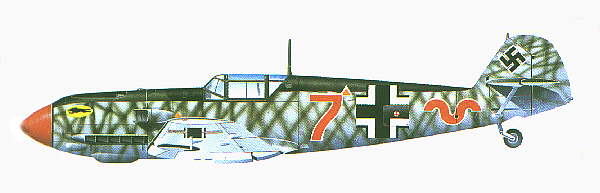
Like most aircraft that were to make a name for themselves, the Messerschmitt 109 had many variants. The original was the Bf109 V1 designed in 1935 and was the first was the first all metal
stressed skin fighter that would enter service. Powered by a 695 hp Rolls Royce Kestrel power plant, it also had a single enclosed cockpit and a retractable undercarriage. The following two
variants, the Bf109 V2 and the Bf109 V3 had a 680hp Junkers Jumo 210A power plant. Both these variants were flying by June 1936.
By December 1936, the variant V4 and V5 was sent to Spain for evaluation and testing and they were redesignated to Bf109B-0 being powered by Jumo 210D engines and an armament of two 7.9mm
machine guns. The first operational Bf109's to see operational service with the Legion Condor in Spain was the 109B but by early 1938 the Bf109C had entered service having a Jumo 210Ga fuel
injected power plant and the addition of two additional machine guns. The Bf109D followed in 1938 which was equipped with the
carburettor powered Jumo 210Da.
Many of the Bf109 aircraft in their development stage still carried the V series, and the Bf109 V10 which had been flying in its experimental stages was using the Daimler Benz DB 600A which was
a carburettor engine in 1937. After further experimental aircraft had been used, the Bf109 V15 was fitted with the all new Daimler Benz DB 601A engine with direct fuel injection which had lifted
the hp rating up to 1,175 hp. This variant was designated the Bf109E-1, the Bf109E-3 being introduced in early 1940. The difference between the E-1 and the E-3 was the addition of two 20mm MG FF
cannon at the expense of two of the machine guns.
Prior to the commencement of WWII and throughout the Battle of Britain the Bf109E was no doubt one of the worlds greatest single seat, single engine fighters. Compared to the British Hurricane
and the Spitfire it was equal to the task and historians and aircraft enthusiasts will argue for many years which was the best aircraft. Overall, possibly of the three the Spitfire just edges to
the fore, but had Germany made the necessary improvements to the Bf109 as the British did to the Hurricane and Spitfire, then the outcome of 1940 may have been different.
The first of the series Bf109E-3 was completed towards the end of 1938, and by the end of 1939 some 1,540 machines had been built with nearly 50 seeing service in the Spanish Civil War. Following
the E3 was the Bf109E-4 which although had no performance improvements, had an improved MG FF cannon and it was this variant that saw service in the Battle of Britain.
Other variants were the Bf 109E-4/B which was a fighter-bomber version that carried one 550lb or four 110lb bombs. The Bf109E-4/N gave slightly improved performance when the DB 601Aa engine
was replaced by the 1200hp DB 601N. The Bf109E-5 and the Bf109E-6 were used and fitted out as reconnaissance fighters being fitted with camera equipment, the Bf109E-5 also having the cannon removed.
The E variant of Bf109 were used extensively until early 1942, where, with the Bf109F
and Bf109G they gave way to the Bf109K in which the pre-series Bf109K-0 was to appear in September 1944.
It is also interesting to note, that a variant of the Bf109E was for use on the carriers Graf Zeppelin and Peter Stasser. Here the wing span was increased as well as the leading edge slats and
ailerons, flap travel was also increased and break points were incorporated for the folding of the wings, and an arrester hook fitted at the rear. This carrier version was designated the Bf109T,
the T indicating 'Träger' or in English, 'Carrier'. Originally ten Bf109E aircraft were converted as Bf109T variants, while about sixty were actually manufactured as Bf109T.
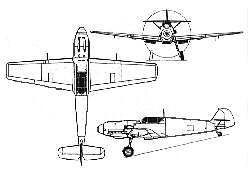
Messerschmitt Bf109E
Specifications
| Type |
Fighter |
| Power Plant |
Daimler-Benz DB601A, of
1,175 hp, direct fuel injection, inline |
| Unladen weight |
4,189 lbs (1,190 kg) |
| Laden weight |
5,875 lbs (2,665 kg) |
| Max Speed (Sea Level) |
290 mph (466 k/ph) |
| Max Speed (14.560 ft) |
348 mph (560 k/ph) |
| Cruising Speed |
233 mph (375 k/ph) |
| Climbing Rate |
3,510 ft/min (17.83 m/sec) |
| Max range |
410 miles (660 kms) at cruising
speed. |
| Service Ceiling |
36,500 feet (11,125 m) |
| Armament |
2xMG FF Cannon (60 rounds
per gun)
2x17.9mm MG Machine Guns
(1,000 rounds per gun) |
| Wingspan |
32ft 4½in (9.87m) |
| Length |
28ft 4½in (8.64m) |
| Height |
8ft 2½in (2.50m) |
| Wing Area |
174.05 sq feet (16.7 sq
m) |
|